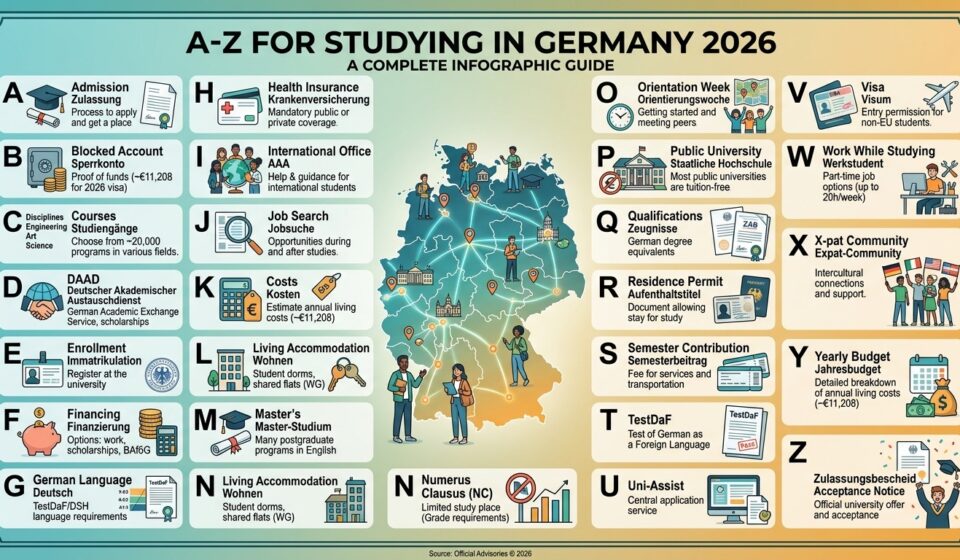

Originally published 2013 · Fully rewritten and updated: September 2026 · Reading time ~12 min
This is the guide I wish I’d had when I applied. It walks you through the entire journey — from picking a university to landing in Germany — in three clear steps. I originally wrote it after doing my own MS in Computer Science, and I’ve now rebuilt it from the ground up for 2026, including the new APS certificate, the current €11,904 blocked-account amount, and the Chancenkarte.
⚠️ Verify official figures before you rely on them. Amounts, fees and rules change. Always confirm on your German embassy’s website and the official portals below before spending money or booking appointments.
The Big Picture: 3 Steps to Germany
- Step 1 — Decide your field and shortlist universities.
- Step 2 — Prepare documents, sit your English test, and apply.
- Step 3 — Get your student visa and arrive in Germany.
Step 1 · Decide Your Field and Shortlist Universities (Cost: Free)
Start at the official DAAD course finder (daad.de → International Programmes). Search by subject, language (English or German), and degree level. I’ll use MS in Computer Science (taught in English) as my running example.
Know the three types of institution
| Type | Best for | Notes |
|---|---|---|
| Universität | Research & PhD track | Theory-heavy; the route if you want a doctorate later. |
| Technische Universität (TU) | Engineering/tech research | Strong industry links; often easier admission than a top Universität. |
| Fachhochschule / Hochschule (UAS) | Going straight into industry | Applied, practical; great job outcomes. PhD still possible via a research thesis. |
💡 Build a shortlist spreadsheet. One row per university: program name, language, deadline, tuition (most public unis are tuition-free, but Baden-Württemberg charges non-EU students €1,500/semester), application platform (uni-assist or direct), and required documents. This one habit saved me weeks.
2026 application deadlines (general)
| Intake | Typical deadline | Notes |
|---|---|---|
| Winter semester (starts Oct) | 15 July | The main intake — most programs open. |
| Summer semester (starts Apr) | 15 January | Fewer programs available. |
Step 2 · Prepare Your Documents and Apply
This is where most applicants lose time. Get these moving in parallel, not one after another.
a) English language certificate
Almost every English-taught program needs IELTS Academic or TOEFL iBT (some accept Duolingo — check per program). One month of focused prep is usually enough. Book early at ielts.org or your local British Council / IDP centre.
b) APS Certificate — new and mandatory for many countries
🔑 Don’t skip this. Students from countries such as India, Pakistan, Bangladesh, Nepal, China, Iran and others now need an APS certificate (academic credential verification) before applying for admission and a visa. Processing can take several weeks — start it first. Check your country’s APS portal for the exact procedure and fee.
c) Attest and photocopy your documents
Get your degree and transcripts attested per your country’s requirements, and make several certified photocopies for uni-assist, the embassy, and enrolment.
d) Passport
Apply for or renew your passport now — it must stay valid well beyond your intended arrival. Everything downstream depends on it.
e) Motivation letter (SOP) and recommendation letters
Write a tailored Statement of Purpose for each program — why this course, why this university, why Germany, and your goals. Secure 2–3 recommendation letters on official letterhead.
f) Submit via uni-assist or directly
Many universities process international applications through uni-assist (~€75 first application, ~€30 each additional). Others accept direct online applications. Your shortlist spreadsheet tells you which is which.
💡 Apply to 6–10 universities across a realistic spread (reach / match / safe). German admissions are competitive and outcomes are unpredictable.
Step 3 · Get Your Student Visa and Arrive in Germany
Once you hold an admission letter, the visa stage begins.
a) Open a blocked account (Sperrkonto)
You must prove you can fund your first year. For 2026 the required amount is €11,904, released at €992/month after arrival.
| Purpose | Monthly | Annual deposit (2026) |
|---|---|---|
| Student visa | €992 | €11,904 |
| Chancenkarte (Opportunity Card) | €1,091 | €13,092 |
The active online providers are Expatrio and Fintiba (Fintiba excludes US citizens). Transfer roughly €12,000–€12,100 so fees don’t drop your balance below the minimum.
b) Get health insurance
You need valid health insurance for the visa — travel insurance for the trip, then German public insurance (TK, AOK, etc.) once enrolled. Expatrio and Fintiba bundle this.
c) Book and attend your visa appointment
Apply for a national visa (D-visa) for study via the German Consular Services Portal and your local embassy/VFS. Typical documents:
- Valid passport + biometric photos
- University admission letter
- APS certificate
- Blocked-account confirmation (Sperrbestätigung)
- Health insurance proof
- Academic certificates, IELTS/TOEFL, SOP, CV
- Completed visa application form + fee (~€75)
💡 Book your appointment the moment you have admission — embassy slots in high-demand countries can be booked out for weeks or months.
d) After you arrive in Germany
- Anmeldung — register your address at the local Bürgeramt within ~2 weeks.
- Activate your blocked account and link a German current account to start receiving €992/month.
- Enrol (Immatrikulation) and pay the semester contribution (often includes a transport ticket).
- Residence permit — convert your entry visa at the Ausländerbehörde before it expires.
- Open a full bank account and get your health-insurance card sorted.
💡 Bring €1,500–€2,000 in unblocked cash. Your first €992 can take 2–3 weeks to release while Anmeldung is processed, and you’ll have deposits and setup costs immediately.
Working and Staying After Graduation (2026)
Students can work up to 140 full days or 280 half days per year alongside studies. After graduating, you can apply for an 18-month post-study residence permit to find a job related to your degree — and later transition to a work permit, EU Blue Card, or the Chancenkarte.
Frequently Asked Questions
How much money do I need for the blocked account in 2026?
€11,904 for a student visa (€992/month), or €13,092 for the Chancenkarte (€1,091/month).
Is the APS certificate mandatory?
For many countries (India, Pakistan, Bangladesh, China, Iran and more) yes — you need it before applying for admission and a visa. Check your country’s APS portal.
Is studying in Germany really free?
Most public universities charge no tuition, only a semester contribution (~€150–€350). Baden-Württemberg charges non-EU students €1,500/semester. You still need to prove living costs via the blocked account.
Do I need German for an English-taught program?
Not for admission, but basic German helps enormously with daily life, part-time work and job hunting. Start learning early.
How long does the whole process take?
Plan for 6–12 months from shortlisting to arrival — APS, admissions and visa appointments are the main bottlenecks.
Disclaimer: Rules, amounts and fees change and vary by country. This guide is informational only, not legal or immigration advice. Always confirm current requirements on official sources (DAAD, uni-assist, your German embassy, and your APS portal) before acting.